
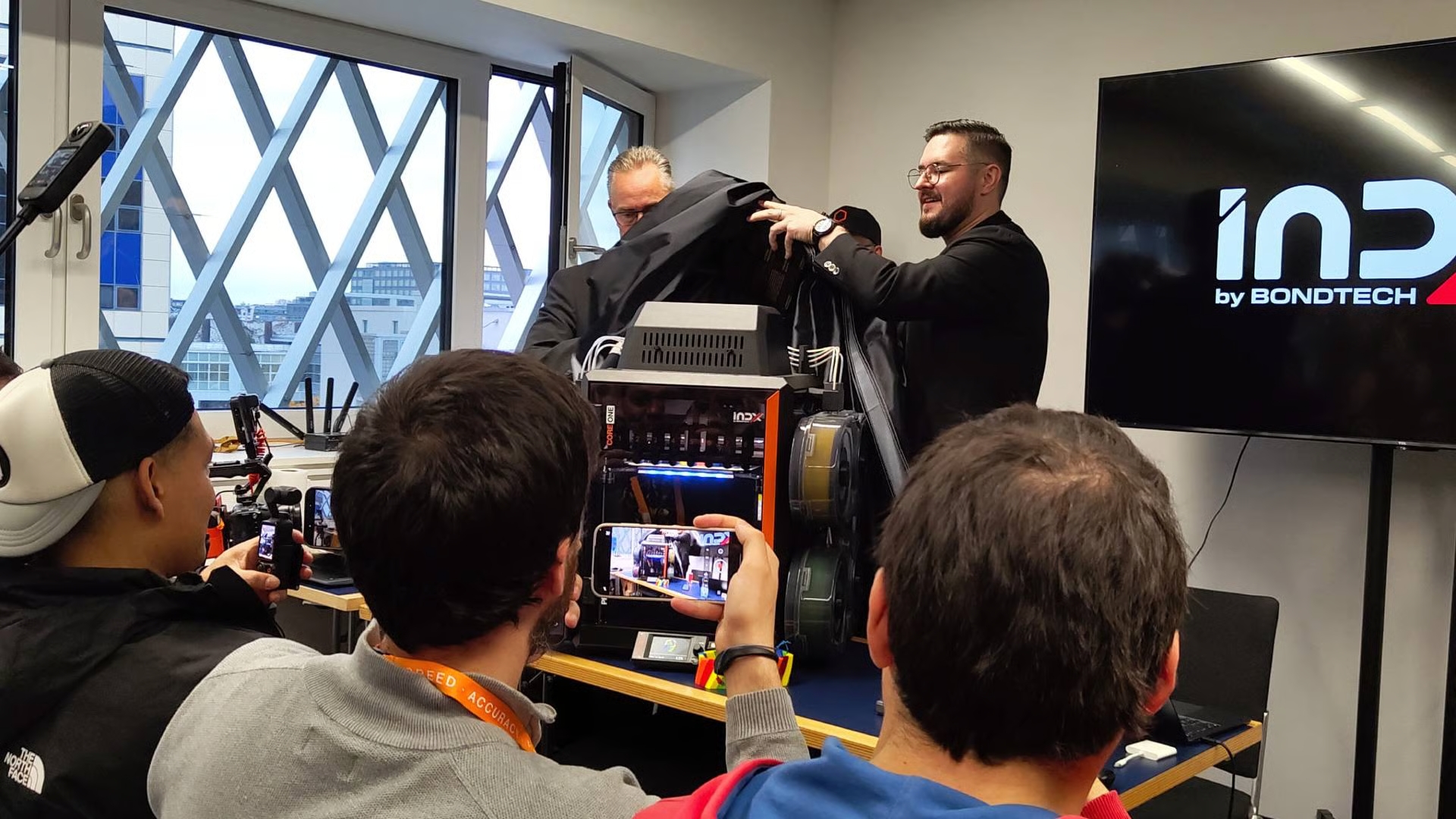
A drip feed of dev videos on Prusa’s YouTube channel is starting to build hype for the INDX upgrade (for us at least) though we’re still waiting for confirmation when this multi-material upgrade will become available.
It feels like an eternity since Formnext, and Prusa’s unveiling of the INDX upgrade for its Core One 3D printers. Stated to release in Q2 2026 – we’re already two-thirds through Q1 – time is ticking on the company and partner Bondtech to deliver on their promise of purgeless 8-filament printing.
But it has not been a complete void of information. We already know what the INDX is and could do. Developed by Bondtech, the INDX was revealed back in March last year as a standalone system, long before Prusa was in the picture as a partner to launch it.
We saw an early version of it in action in Frankfurt for the Core One-capable INDX reveal. But as for some of the finer details of how it works and the practicalities of it, Prusa has taken to YouTube with a string of short videos to explain.
How Do You Mount 8 Filament Spools to a Core One?
A fair question, given the Core One’s compact footprint. It’s not a massive printer, so understanding how 8 spools are supposed to mount to the machine might not be the most obvious thing, particularly to anyone who’s experienced the company’s MMU and had to live with the five-spool sprawl that requires.
The first quick look video at the INDX for Core One shows that it’s a simple 4:4 split, mimicking the Prusa XL in simply mounting to the printer’s side. One core difference is in the how – where the XL uses T-slot nuts running in that printer’s aluminum extrusion frame, the Core One has existing holes in its body for you to use. By default these have nylon rivets in, but here they double up as mounting points for Prusa’s universal spool holder system.
It’s a simple case of bolting the inner brace to the printer, with a removable spool-holding core (of which there are community-designed alternatives, too) screwing in place after.
Prusa’s Universal Storage System (USS) drybox fits on these holders, too, letting you mount 8 boxes for hygroscopic filaments and long-term, protected use.
How Does Mesh Bed Leveling Work?
Early prototypes, including those shown at Formnext, used Prusa’s classic PINDA probe (mounted to the side of the toolhead carriage) for probing the bed and providing the data for mesh bed calculations.
The final, production version of the Core One’s INDX uses a load cell sensor instead, integrated into the toolhead carriage. When a nozzle is picked up it becomes the probe, with the load cell registering resistance when the nozzle is tapped off against the bed. This method aligns the INDX system on the Core One with all of the company’s current machine line-up (besides the Mini+, which uses a SuperPINDA probe sitting shotgun to the nozzle).
What Does “INDX” Even Mean?
In my opinion this is the most interesting question of the bunch, given existing acronyms in 3D printing like IDEX look very similar to INDX. It peels back some layers of information that may not wholly be obvious.
The “IN” in INDX does not stand for “independent” – it represents “induction”, the process by which the toolhead quickly heats up the nozzles. This is relatively novel tech in desktop printing, with the only other commercial implementation of it that we’re aware of being Bambu Lab’s Vortek system, in the H2C 3D printer.
In short, high-frequency AC power to drive a copper coil in the INDX’s toolhead carriage, generating an electromagnetic field. The INDX’s nozzles, when picked up by the toolhead, sit within this field and, through the effect of electromagnetic induction generated by the field from the coil, heat up very quickly.
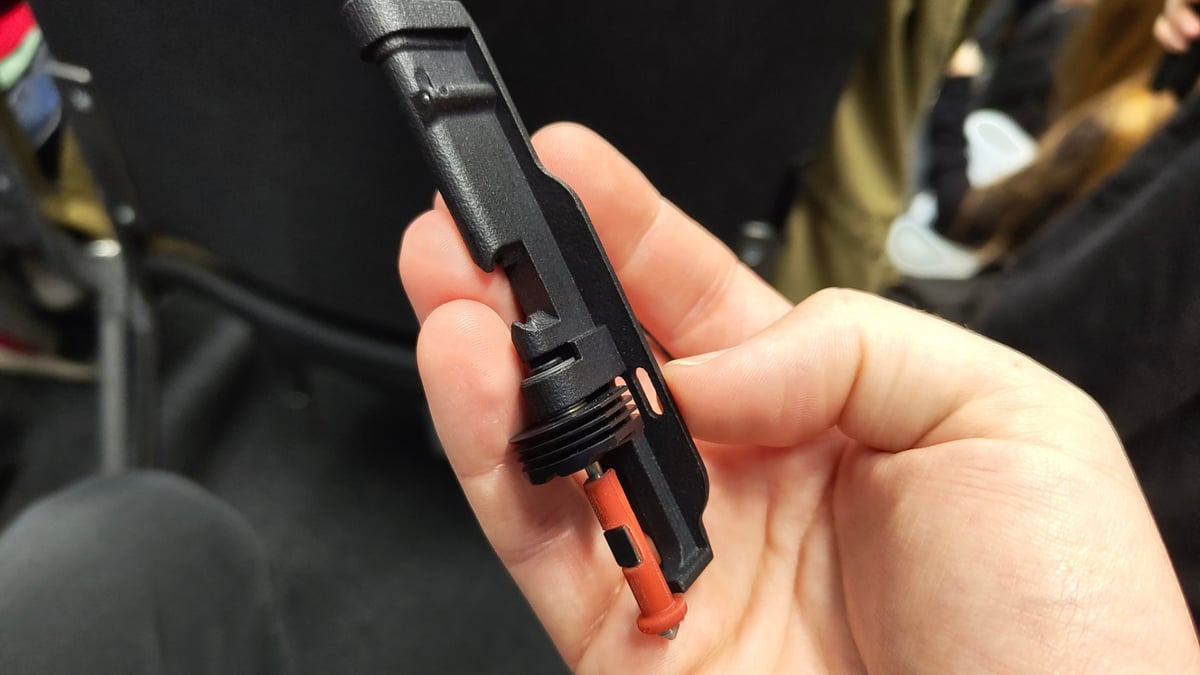
The current generated in the nozzles by the coil is called an Eddy Current, which gets its name from circular currents in bodies of water, known as eddies. Like those water currents, the electromagnetic field generated by the coil excites the electrons in the INDX’s nozzles to churn in a loop. The metal of the nozzle resists this flow, releasing the energy as heat.
The “DX” of INDX comes from “Dynamic eXtrusion”. The INDX as a toolchanging system is a little different that we’ve seen before.
Rather than picking and parking full, complete tools with extruder, hotend, controller et al., like we see in the Prusa XL or the newer Snapmaker U1, the INDX has just one extruder, and picks and parks an array of nozzles. The filament paths are tied to the specific nozzles, too. If you take a second to think about it, this presents a unique question – “how can the extruder feed the filament if it’s already in the nozzle?”.
We’re used to the extruder on a 3D printer being being a closed box of gears. Filament feeds in from the top and grabbed by the gears. The INDX instead removes one side, with a mechanism to dynamically disengage and engage the gears to grip and feed the filament. A consequence of this is that the INDX can adjust the tension to suit the characteristics of the filament – Bondtech calls this pre-tensioning system Dynamic Dual Drive
For now, the wait goes on for this significant Core One upgrade. While we’ve no new details about the specific timing of the launch, we can assume the nature of the retail release remains as communicated at the reveal:
Initially only for the Core One+, with the Core One L to follow later, the INDX will ship as an upgrade kit. Two forms of kit will be available: a 4-toolhead for $499, and an 8-toolhead for $699. This is close-ish to Bondtech’s initial price estimate for the INDX as a standalone product (which was $250 for the smart toolhead, and $35 a pop for the nozzles).
A 1000-unit founder’s edition was available at the reveal late last year, selling out in five hours. The Core One+ is available now for $999 for the kit, or $1,299 fully assembled, and is the only way to access the INDX when it does launch later this year.
Back at the INDX upgrade kit’s reveal, we polled you on which printer you’d get out of the Core One with INDX, Snapmaker U1, and Bambu Lab H2C, with the INDX the clear frontrunner at over 50% of the vote. Is that still the case, or has time dimmed the excitement?